


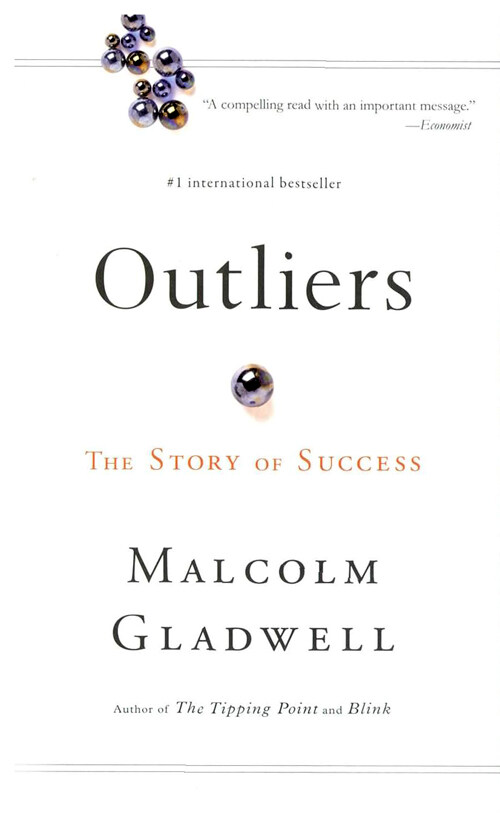
![Outliers : The Story of Success [빌 게이츠 추천도서]](/shopimages/tongbang/050000007566.jpg?1729053385 "Outliers : The Story of Success [빌 게이츠 추천도서]")
-
Malcolm Gladwell (말콤 글래드웰)
Outliers : The Story of Success [빌 게이츠 추천도서] (Mass Market Paperback)
AR : 7.8
Hachette Book | Malcolm Gladwell (말콤 글레드웰)- ISBN : 9780316056281
15,000원
- 『아웃라이어 - 성공의 기회를 발견한 사람들』 영어원서

기본정보
| 출간일 | 2009-06-01 |
|---|---|
| 구성/판형 | Mass Market Paperback | 384 pages |
| 크기 | 106 x 171 x 32mm |
| 상품번호 | 20873 |
“타고난 지능, 탁월한 재능, 끊임없는 열정과 노력이 정말 성공을 보장하는가?
그동안 우리가 알고 있던 성공의 비결은 모두 틀렸다!”
빌 게이츠는 타고난 컴퓨터 천재인가? 모차르트는 위대한 클래식 신동인가? 빛나는 성공을 거둔 사람들에게는 정말 평범한 사람이 감히 근접할 수 없는 재능과 지능, 아니면 그 무언가가 있는 것인가?
『아웃라이어』는 보통 사람의 범위를 넘어서는 비범한 사람, 즉 천재들에 관한 이야기다. 『블링크』『티핑포인트』로 유명한 말콤 글래드웰이 4년간의 공백을 깨고 탄생시킨 이 책은 ‘비약적으로 성공한 사람’ ‘상위 1%의 부자(로버 베론)’ ‘천재’들이 지니는 ‘일반적인 성공 매커니즘과 이유(선천적 재능, 타고난 직관력, 우월한 신체조건, 높은 IQ)’ 또는 ‘가난한 환경을 노력으로 극복했다는 신파적 반전 드라마’를 정면으로 반박하였다.
이 책은 성공한 사람은 무에서 유를 창조하는 것이 아니라 숨겨진 이점과 특별한 기회요소, 그리고 문화적 유산과 역사적 공동체의 혜택을 누려왔다고 지적하며, 재능과 지능, 놀라운 성공신화는 존재하지 않는다고 말한다. ‘특별한 기회’와 ‘역사·문화적 유산’의 두 측면에서 ‘상위 1%의 성공 비결’을 파헤친 이 책은 인류의 영원한 관심사 ‘성공과 부’의 비밀을 밝히는 경영교양서이자 성공지침서가 될 수 있을 것이다.
It's not uncommon, reading a newspaper or watching television, to learn that science has just discovered something everyone already knows. Often it sounds like awful stand-up: "Men, women different, finds ten-month toilet-seat study" or "Drunk researchers: 'Beer goggles' real." If Malcolm Gladwell's Outliers: The Story of Success were pared down to a headline, it would be "Gladwell: Life Unfair."
This isn't strictly a criticism. The mechanisms of life's unfairness are fascinating, and Gladwell does a mostly good job of reverse-engineering them. His thesis is: "[I]t is not the brightest who succeed.... The successful are those who have been given opportunities -- and who have had the strength and presence of mind to seize them." Few would argue with this, or be surprised by it, but many will be enchanted by the curious assortment of examples he uses to bolster it. Whether they'll be put off by his logical contradictions and obfuscations is another matter.
The first of Gladwell's examples concerns hockey. It turns out that given "any elite group of hockey players...40 percent of the players will have been born between January and March." The reason for this is about as mind-blowing as the Masonic symbols on a dollar bill: The selection pool is made up of subjects born in a calendar year. Players born toward the beginning of the year have months of practice and development on those born toward the end.
The process could be made more egalitarian by confining the selection pool to, say, a month, or a day. Gladwell would settle for "two or even three hockey leagues, divided up by month of birth." Such an arrangement may be in the interest of boys who want to play hockey, but what about the officials being asked to administer and coach three times as many teams?
It never occurs to Gladwell that scouting talent isn't about fairness or self-esteem; it's about putting excellent players in the rink. Later in the book he arrives at the concept of good enough, the fact that above a particular IQ threshold, the success of one subject is as likely as the success of another. Why has he not also arrived at the similar concept of fair enough, the fact that there comes a point of diminishing returns in trying to achieve total equality of opportunity?
Gladwell sees unfairness everywhere, but particularly in education. He proposes that the "good enough" threshold be used in college admissions: Everyone scoring higher than X on standardized tests should be subjected to selection by lottery. He then states, in apparent contradiction of his proposal, "If intelligence matters only up to a point, then past that point, other things...must start to matter more." (So why leave them to chance?) Creativity, he suggests, could be measured with something called a "divergence test."
Or -- may I propose a less novel method? -- something called a "college essay."
Gladwell uses the term "outlier" to refer to a remarkable person -- or, rather, a person who seems remarkable but is in fact the beneficiary of dumb luck. In statistics, an outlier is a data point far enough from the mean as to be statistically misleading, not statistically explanatory.
Yet Gladwell purports to decipher the whole from the outlying part. Consider some of his examples: the Beatles, Bill Joy, and Bill Gates. All three support the "10,000-Hour Rule" propounded by Gladwell later in his book: Nobody who succeeds does so without 10,000 hours of practice. The Beatles put in their time at a Hamburg club where they were made to perform eight hours a night. Joy and Gates, too, were products of unusual circumstances affording them an unprecedented amount of programming time.
Gladwell allows that ability is important, but argues that opportunity is paramount. Here he commits the logical fallacy that deep-sixes his thesis. Talent without opportunity will yield limited or no achievement. Fine, but what will opportunity without talent yield? What would you or I do with 10,000 hours at a primitive computer terminal? Probably cry our eyes out.
Further, Gladwell doesn't ask whether the stamina to do anything for 10,000 hours is itself a kind of innate ability. He takes it on faith that any talented person, given 420 days with a hockey stick, computer, glockenspiel, or Moleskine notebook would stride into the annals of genius. An early definition of giftedness set forth by Joseph Renzulli required the intersection of three traits. Two were creativity and above-average ability. What was the third? Task commitment.
The Beatles, as the Hamburg example suggests, had task commitment cold. The thing is, they also had more creativity than their contemporaries. Surely Gladwell understands that every touring band -- Herman's Hermits, to pick one at random -- got in 10,000 hours of performing time. They had nothing on a true outlier, a band towering so high above the competition that no normal metric could explain it.
Here is the most telling slip-up in Outliers, in a passage about Steve Jobs. "Wait. Bill Hewlett gave him spare parts? That's on par with Bill Gates getting unlimited access to a time-share terminal at age thirteen." No. The incredible thing isn't that young Steve was given spare parts. It's that he asked for them. It was "lucky" that Bill Hewlett said yes to his request, but how many young people demonstrate that kind of initiative, that fearless impulse to make their own luck?
The reader is breathlessly informed that all the giants of the computing and software revolution were born around the same time. Luck! This is a case of circular logic: These men could hardly have participated in the tech revolution without being present for it. (Suspicious, isn't it, that none of these Silicon Valley tycoons was born in the 19th century?)
One fact Gladwell determinedly ignores is that genius lies in using the advantages to hand. Men as brilliant as Joy, Gates, and Jobs -- and John, Paul, and George -- could work with their circumstances because they could have worked with nearly any circumstances. He is correct to say that one's background plays a role in success. He is at his best when showing that Asians inherited a culture of hard work from the year-round agriculture of the rice paddy, and that they owe their heightened mathematical ability to the linguistic accident that number words in Asian languages are shorter than in European ones. But that explains a group's advantage, not an individual's.
Life really isn't fair. Some come of age on the cusp of great paradigm shifts. Some are born on January 1st and have hockey sticks stuffed through the bars of their cribs. And some are Asian. But only outliers outlie. Lots of people were born on February 24, 1955, Steve Jobs's birthday. Many infants have the good fortune to be born on January 1st in Moose Jaw, Saskatchewan. Lord knows, Asians are Asia's most plentiful export. Why aren't all of them showing us up? Why aren't we playing hockey on Mars by now?
Perhaps because Gladwell has focused on the circumstances of individual "outliers," less so their remarkable outlying traits. Accidents are accidental, but to capitalize on them takes something extra. --Stefan Beck
A writer living in Palo Alto, California, Stefan Beck has written for The Wall Street Journal, The New York Sun, The Weekly Standard, The New Criterion, and other publications.
- 등록된 상품후기가 없습니다.