


20,900원
(23%↓)
16,000원
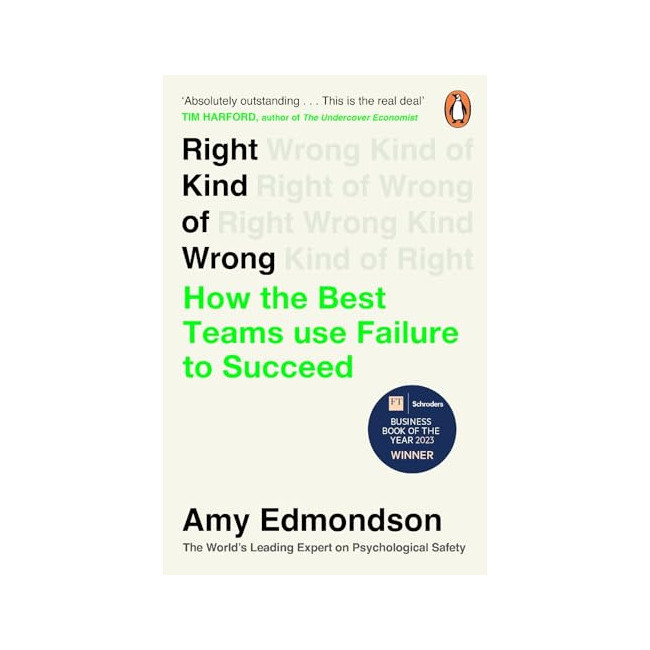
Right Kind of Wrong: Why Learning to Fail Can Teach Us to Thrive (Paperback, 영국판)


Winner of the Financial Times Business Book of the Year Award
‘Absolutely outstanding’ Tim Harford, author of The Undercover Economist
'A masterclass’ Angela Duckworth, author of Grit
‘Excellent’ Andrew Hill, Financial Times
We used to think of failure as a problem, to be avoided at all costs. Now, we're often told that failure is desirable - that we must ‘fail fast, fail often’. The trouble is, neither approach distinguishes the good failures from the bad. As a result, we miss the opportunity to fail well.
Here, Amy Edmondson – the world’s most influential organisational psychologist – reveals how we get failure wrong, and how to get it right. Drawing on four decades of research into the world’s most effective teams, she unveils the three archetypes of failure – basic, complex and intelligent - and explains how to harness the revolutionary potential of the good ones (and eliminate the bad). Along the way, she poses a simple, provocative question: What if it is only by learning to fail that we can hope to truly succeed?
‘Lays out a clearer path about how to stop avoiding failure and take smarter risks.’ Books of the Year, Financial Times
‘Absolutely outstanding’ Tim Harford, author of The Undercover Economist
'A masterclass’ Angela Duckworth, author of Grit
‘Excellent’ Andrew Hill, Financial Times
We used to think of failure as a problem, to be avoided at all costs. Now, we're often told that failure is desirable - that we must ‘fail fast, fail often’. The trouble is, neither approach distinguishes the good failures from the bad. As a result, we miss the opportunity to fail well.
Here, Amy Edmondson – the world’s most influential organisational psychologist – reveals how we get failure wrong, and how to get it right. Drawing on four decades of research into the world’s most effective teams, she unveils the three archetypes of failure – basic, complex and intelligent - and explains how to harness the revolutionary potential of the good ones (and eliminate the bad). Along the way, she poses a simple, provocative question: What if it is only by learning to fail that we can hope to truly succeed?
‘Lays out a clearer path about how to stop avoiding failure and take smarter risks.’ Books of the Year, Financial Times
총
0
개의 상품평
- 등록된 상품후기가 없습니다.