


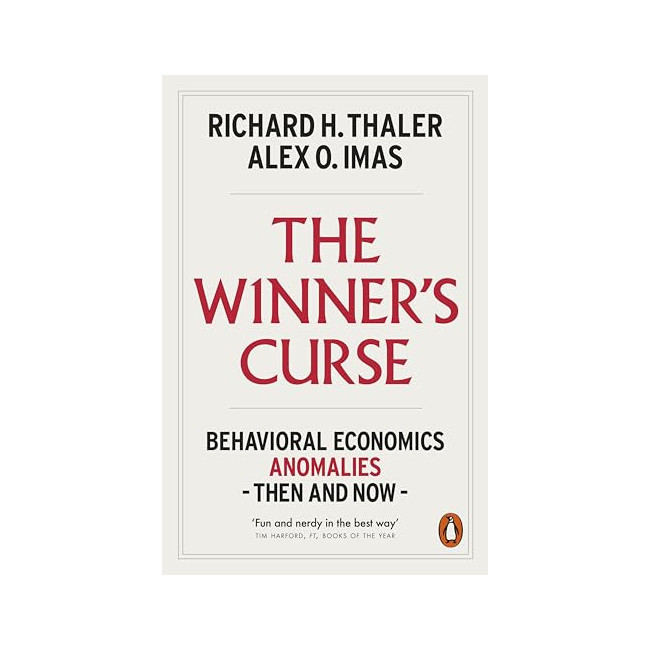

The Winner's Curse: Behavioral Economics Anomalies Then and Now (Paperback, 영국판)
27,300원
- 『승자의 저주』영어원서


왜 사람들은 아무런 인센티브가 없는데도 서로 협력할까요? 왜 가치도 없는 물건을 버리지 못하고 움켜쥐고 있으며, 경매의 승자는 왜 종종 실망하곤 할까요? 노벨 경제학상 수상자이자 『넛지』의 공동 저자인 리처드 탈러와 스타 경제학자 알렉스 임스가 인간은 경제학 교과서처럼 이기적이고 합리적으로만 행동하지 않는다는 사실을 흥미롭게 파헤칩니다. 30년 전 행동경제학의 기반이 되었던 도발적인 질문들을 오늘날의 시점으로 가져와, 밈 주식과 도지코인이 판치는 현대 금융 시장에서도 여전히 유효한 인간의 불완전한 선택들을 낱낱이 짚어냅니다.
은퇴 자금 저축부터 신용카드 대금 결제, 심지어 골프 프로 선수의 퍼팅 실수나 포트폴리오 매니저의 주식 매도 결정에 이르기까지 전문가조차 빠지는 기만적인 오류들이 책 곳곳에서 펼쳐집니다. 이 책은 경제학을 전혀 모르는 대중부터 동료 경제학자까지 누구나 쉽게 읽을 수 있으면서도 깊이 있는 통찰을 제공합니다. 주변 친구나 동료, 고객들이 왜 그런 선택을 하는지 그 행동의 이면을 이해하고, 나아가 나 자신도 더 나은 결정을 내릴 수 있도록 돕는 유쾌하고도 날카로운 행동경제학 가이드북, 『승자의 저주(The Winner’s Curse)』입니다.
‘My book of the year … the father of behavioural economics makes a pugnacious case that humans do not behave as the economics textbooks say’ Tim Harford, FT
Nobel Prize-winner and co-author of Nudge, Richard Thaler, and star economist Alex Imas explore behavioral economics in this fully updated edition of the seminal work The Winner’s Curse
Why do people cooperate with one another when they have no incentive to do so? Why do we hold onto possessions of little value? And why is the winner of an auction so often disappointed?
Over thirty years ago, Richard Thaler introduced readers to behavioral economics in his seminal Anomalies column, written with collaborators including Daniel Kahneman and Amos Tversky. These provocative articles challenged the fundamental idea at the heart of economics that people are selfish, rational optimizers, and provided the foundation for what became behavioral economics. That was then. Now, three decades later, Thaler has teamed up with economist Alex Imas to write a new book. Every chapter starts with an original Anomaly, retaining the spirit of its timestamp. Then, shifting to the present, they provide current updates to each, asking how the original findings have held up and how the field has evolved since then.
It turns out these findings still show up almost everywhere. Anomalies pop up in people’s decisions to save for retirement and how they carry outstanding credit card debt. Even experts fail to optimize. The key concept of loss aversion explains missed putts by golf pros and the selection of which stocks to sell by portfolio managers. In this era of meme stocks and Dogecoin, it is hard to defend the view that financial markets are highly efficient. The good news, however, is that the anomalies have got much funnier.
With both readability and rigor, The Winner’s Curse illuminates these ideas for anyone – from those with a cursory understanding of economics to fellow economists. Each chapter provides a key insight into human behavior so readers learn how to better understand the choices made by their friends, colleagues, and customers, and might just become better at making decisions themselves.
Nobel Prize-winner and co-author of Nudge, Richard Thaler, and star economist Alex Imas explore behavioral economics in this fully updated edition of the seminal work The Winner’s Curse
Why do people cooperate with one another when they have no incentive to do so? Why do we hold onto possessions of little value? And why is the winner of an auction so often disappointed?
Over thirty years ago, Richard Thaler introduced readers to behavioral economics in his seminal Anomalies column, written with collaborators including Daniel Kahneman and Amos Tversky. These provocative articles challenged the fundamental idea at the heart of economics that people are selfish, rational optimizers, and provided the foundation for what became behavioral economics. That was then. Now, three decades later, Thaler has teamed up with economist Alex Imas to write a new book. Every chapter starts with an original Anomaly, retaining the spirit of its timestamp. Then, shifting to the present, they provide current updates to each, asking how the original findings have held up and how the field has evolved since then.
It turns out these findings still show up almost everywhere. Anomalies pop up in people’s decisions to save for retirement and how they carry outstanding credit card debt. Even experts fail to optimize. The key concept of loss aversion explains missed putts by golf pros and the selection of which stocks to sell by portfolio managers. In this era of meme stocks and Dogecoin, it is hard to defend the view that financial markets are highly efficient. The good news, however, is that the anomalies have got much funnier.
With both readability and rigor, The Winner’s Curse illuminates these ideas for anyone – from those with a cursory understanding of economics to fellow economists. Each chapter provides a key insight into human behavior so readers learn how to better understand the choices made by their friends, colleagues, and customers, and might just become better at making decisions themselves.
총
0
개의 상품평
- 등록된 상품후기가 없습니다.